Eqvira
Learn
Hoof photo documentation that holds up over time.
A simple system you can repeat without stress.
A practical way to take consistent hoof photos and keep them organized by horse and date so you can compare over
time and share a clear record when it matters.
Not medical advice.
This is a documentation and organization system. It is designed to make your photos comparable and your timeline
easier to share, not to diagnose, predict, or replace a professional.
The camera roll problem
Your photos become a junk drawer when they are not grouped or labeled.
Angles drift over time
Changing distance, lighting, and framing makes comparisons fuzzy.
Memory fades
When it is time to talk with a farrier or vet, you end up scrolling and guessing.
The fix is not more photos. The fix is repeatable photos plus simple labeling so your timeline stays intact.
Step 1: Capture consistently
Views: dorsal, solar, lateral
Cadence: monthly baseline, plus post-trim moments if helpful
Goal: repeatable framing, not artistic perfection
Step 2: Label once
Horse name (or ID)
Date
Hoof (LF / RF / LH / RH)
View (dorsal / solar / lateral)
Optional: 1-2 quick notes
Step 3: Compare and share
Compare weeks or months apart with less guesswork
Share a clean timeline at appointments
Reduce the "what was that from?" moments later
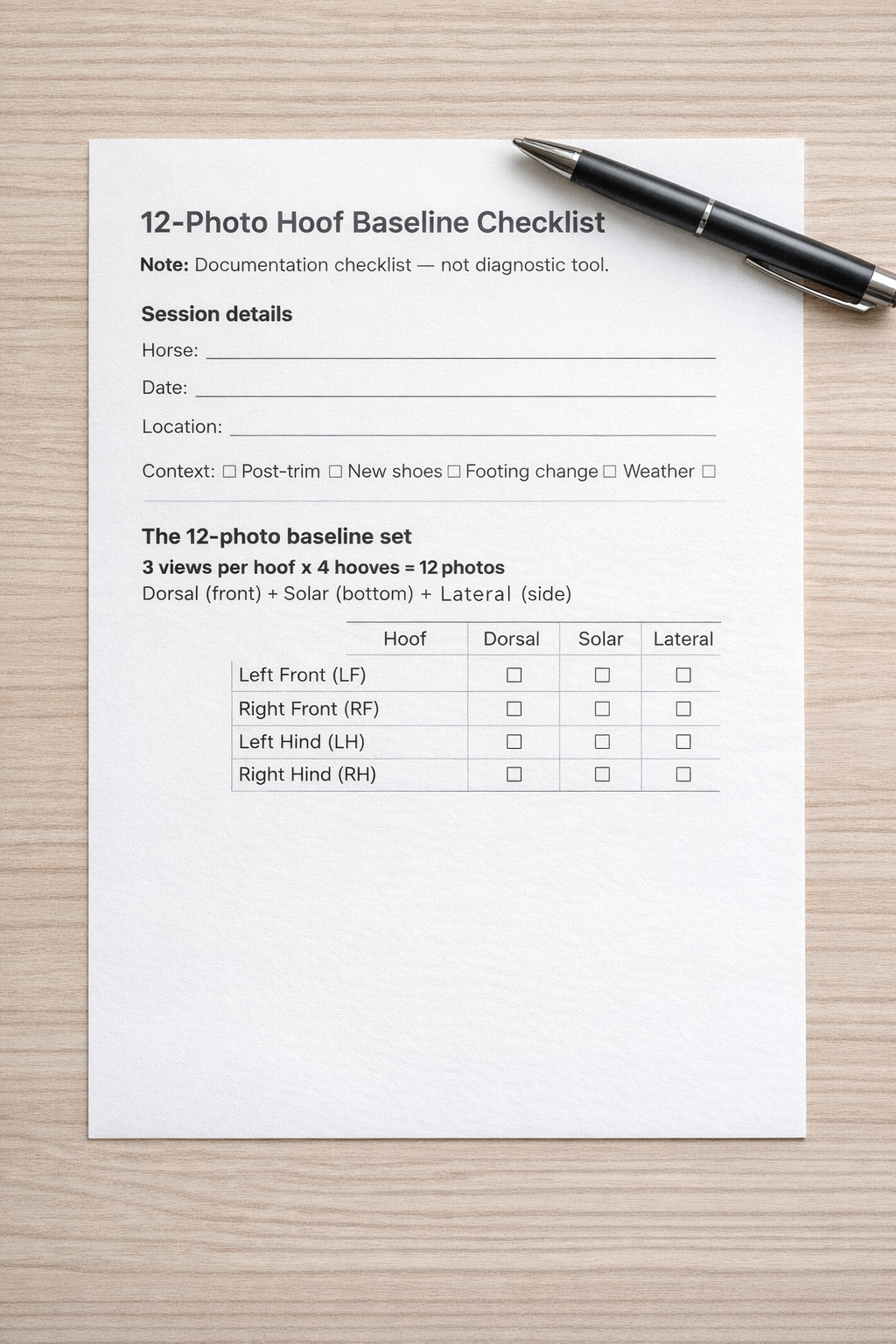
For each hoof (LF / RF / LH / RH)
Dorsal (front view)
Solar (bottom view)
Lateral (side view)
That is 3 views x 4 hooves = 12 photos.
Quick setup
Choose a spot with decent light (open shade works well).
Keep the background simple and avoid harsh shadows.
Use the same spot whenever you can.
Baseline rhythm
Monthly: one complete 12-photo set.
Plus: after trims or shoeing if you want tighter comparisons.
If you miss a month, nothing breaks. Capture the next baseline and keep going.
Printed 12-photo baseline checklist.
See cadence options for a simple rhythm.
Get the baseline checklist
Includes: one-page checklist + quick labeling format.
No email required.
You do not need perfect lighting or a fancy setup. You need repeatable framing.
Read the full guide on angle, distance, and light.
The three consistency levers
Framing (what is in the photo)
Distance (how close you are)
Angle (where you stand and how you aim)
General photo rules
Fill the frame with the hoof and a little leg.
Keep the camera steady for a clean edge line.
Use the same orientation each time (portrait or landscape).
Photograph in the same location when possible.
Dorsal (front view)
Aim straight toward the front of the hoof.
Keep the hoof centered and symmetrical in frame.
Avoid strong side angles that distort shape.
Lateral (side view)
Photograph from the side at hoof level.
Keep the camera parallel to the hoof wall.
Avoid shooting down from above.
Solar (bottom view)
Capture the bottom clearly with even light.
Make sure the hoof fills the frame.
Avoid harsh shadow across the sole.
The goal is a comparable record. If you can repeat your "good enough" setup, you win.
Do this
Use the same spot and distance when possible.
Keep framing consistent (hoof plus a little leg).
Take a quick second shot if the first is blurry.
Capture all 12 photos in one pass.
Avoid this
Random angles each session.
Shooting from above for lateral shots.
Backlit photos where the hoof becomes a silhouette.
Splitting one set across multiple days.
Fix common photo problems fast.
The moment you label a photo, it becomes easier to use later—especially when you need to share it.
Read the full guide on labeling and session grouping.
A labeling format that holds up
HorseName_YYYY-MM-DD_Hoof_View
Examples:
Juniper_2025-12-28_LF_Dorsal
Juniper_2025-12-28_LF_Solar
Juniper_2025-12-28_LF_Lateral
Add one small note (optional)
Post-trim
New shoes
Wet week
Footing change
Notes are most useful when they describe events, not interpretations.
Keep sets together
Group by horse.
Group by date or session.
Keep each session complete with all 12 views.
This is where a tool like Eqvira helps. It is built around sessions, views, and timelines so your records do not
fall apart in a camera roll.
A clean record improves conversations because it reduces guesswork and scrolling.
Read the guide on comparing hoof photos over time.
Read the guide on sharing a record for appointments.
What is helpful to share
The baseline set for a specific date.
A comparison set (one month ago vs today).
A short note on context (trim, shoeing, footing change).
What to avoid
Over-interpreting photos in writing.
Turning documentation into diagnosis.
Sending a chaotic camera roll without labels.
A good record makes it easier to say, "Here is the timeline" and "Here are the same views from last month and today."
Baseline completeness check
Did you capture all 12 photos before you move on?
Label builder
Generate consistent names using horse, date, hoof, and view.
Session grouping
Keep each baseline set together so it is easy to find later.
These are the types of small utilities Eqvira is designed to support.
How often should I take hoof photos?
A monthly baseline is a solid starting point. Add a set after trims or shoeing if you want tighter comparisons.
What if my horse will not stand still?
Start with good enough. Take the baseline in short bursts if needed. Consistency improves once the routine settles.
Do I need perfect lighting?
No. Even lighting helps, but repeatable framing and distance matter more than perfection.
Can I start with photos I already have?
Yes. Use them as history. Going forward, capture complete baseline sets so comparisons improve over time.
How do I share this with my farrier or vet?
Share one baseline set or two dates for comparison with clear labels and a short context note.
Ready to start?
A simple record beats a perfect memory.
Want the fundamentals? Visit the photo fundamentals .
Get the baseline checklist
No email required.